Independent EAA accessibility audits
EAA accessibility audits for websites and digital services.
Get a human-tested, prioritised report that shows which barriers block customers, why they matter, and how your team should fix them.
90-second scope check
Does the EAA likely apply to your organisation?
Answer six questions for an initial indication based on the European Accessibility Act and the law of the EU market you select.
Your answers stay in this browser. Nothing is sent or stored.
Initial indication
A microenterprise service exemption may apply
Your answers match the headline size test for a microenterprise and describe a service rather than a covered product.
Article 4(1) of the Polish Accessibility Act excludes services offered or provided by microenterprises. The exemption does not remove duties for covered products, and linked-enterprise rules can affect the size calculation.
If the exemption does not apply: an administrative penalty may reach 10 times the preceding year’s average monthly wage, capped at 10% of turnover in the preceding financial year. A notification may lead to control. The Act gives PFRON 30 days to consider or forward a notification, but sets no fixed duration for the full enforcement process.
Official sources: Polish Accessibility Act and current Polish microenterprise definition.
This is an initial indication, not legal advice or a compliance decision. Group structure, linked enterprises, product roles, contracts, transitional rules, and national law can change the result.
Request a scope reviewInitial indication
EAA obligations are likely relevant
Your answers point to a covered EU market activity without the service-provider microenterprise exemption.
The Polish Accessibility Act covers specified consumer products and services, including e-commerce. Its microenterprise exclusion applies to services, not to covered product duties.
Potential penalty: up to 10 times the preceding year’s average monthly wage, capped at 10% of turnover in the preceding financial year. A notification may lead to control. PFRON has a 30-day step to consider or forward it, but the full process has no fixed statutory duration.
Official sources: Polish Accessibility Act and current Polish microenterprise definition.
This is an initial indication, not legal advice or a compliance decision. Group structure, linked enterprises, product roles, contracts, transitional rules, and national law can change the result.
Request a scope reviewInitial indication
The scope needs a closer review
One or more answers do not establish whether the activity or exemption test is met.
Polish scope depends on the exact product or service, consumer market, economic-operator role, enterprise calculation, and transitional facts. Do not rely on the microenterprise exclusion until those points are confirmed.
Official sources: Polish Accessibility Act and current Polish microenterprise definition.
This is an initial indication, not legal advice or a compliance decision. Group structure, linked enterprises, product roles, contracts, transitional rules, and national law can change the result.
Request a scope reviewInitial indication
Direct EAA exposure appears less likely
You indicated that you do not offer the relevant product or service in an EU market.
The Polish Act focuses on covered products and services offered in its market. Cross-border sales, future market entry, public-sector rules, or other accessibility laws can change this indication.
Official sources: Polish Accessibility Act and current Polish microenterprise definition.
This is an initial indication, not legal advice or a compliance decision. Group structure, linked enterprises, product roles, contracts, transitional rules, and national law can change the result.
Request a scope reviewInitial indication
A microenterprise service exemption may apply
Your answers match the headline size test for a microenterprise and describe a service rather than a covered product.
Section 3(3) BFSG excludes microenterprises that offer or provide services. It does not remove duties attached to covered products, and partner or linked-enterprise facts can affect the size calculation.
If the exemption does not apply: certain core BFSG violations may be fined up to €100,000. Other listed offences may be fined up to €10,000. The law does not set one fixed duration for the complete enforcement process.
Official sources: BFSG section 3 and BFSG section 37.
This is an initial indication, not legal advice or a compliance decision. Group structure, linked enterprises, product roles, contracts, transitional rules, and national law can change the result.
Request a scope reviewInitial indication
EAA obligations are likely relevant
Your answers point to a covered EU market activity without the service-provider microenterprise exemption.
The BFSG covers specified consumer products and services, including e-commerce services. Its microenterprise exclusion applies to service providers, not to covered product duties.
Potential fine: certain core violations may be fined up to €100,000 under section 37 BFSG. Other listed offences may be fined up to €10,000. The complete enforcement process has no single fixed statutory duration.
Official sources: BFSG section 3 and BFSG section 37.
This is an initial indication, not legal advice or a compliance decision. Group structure, linked enterprises, product roles, contracts, transitional rules, and national law can change the result.
Request a scope reviewInitial indication
The scope needs a closer review
One or more answers do not establish whether the activity or exemption test is met.
German scope depends on the exact product or service, consumer market, economic-operator role, enterprise calculation, and transitional facts. Do not rely on the microenterprise exclusion until those points are confirmed.
Official sources: BFSG section 3 and BFSG section 37.
This is an initial indication, not legal advice or a compliance decision. Group structure, linked enterprises, product roles, contracts, transitional rules, and national law can change the result.
Request a scope reviewInitial indication
Direct EAA exposure appears less likely
You indicated that you do not offer the relevant product or service in an EU market.
The BFSG focuses on covered products and services placed or offered on the German market. Cross-border sales, future market entry, public-sector rules, or other accessibility laws can change this indication.
Official sources: BFSG section 3 and BFSG section 37.
This is an initial indication, not legal advice or a compliance decision. Group structure, linked enterprises, product roles, contracts, transitional rules, and national law can change the result.
Request a scope reviewInitial indication
A microenterprise service exemption may apply
Your answers match the headline size test for a microenterprise and describe a service rather than a covered product.
The EAA framework exempts microenterprises providing services, but each member state applies the Directive through national law. Confirm the national definition, scope, enforcement body, and any local conditions. The exemption does not cover duties for covered products.
Official source: Directive (EU) 2019/882. National implementation and sanctions vary.
This is an initial indication, not legal advice or a compliance decision. Group structure, linked enterprises, product roles, contracts, transitional rules, and national law can change the result.
Request a scope reviewInitial indication
EAA obligations are likely relevant
Your answers point to a covered EU market activity without the service-provider microenterprise exemption.
The activity appears relevant to the EAA framework. The applicable national law determines the exact duties, authority, procedure, and sanction ceiling, so a country-specific check is required before relying on this result.
Official source: Directive (EU) 2019/882. National implementation and sanctions vary.
This is an initial indication, not legal advice or a compliance decision. Group structure, linked enterprises, product roles, contracts, transitional rules, and national law can change the result.
Request a scope reviewInitial indication
The scope needs a closer review
One or more answers do not establish whether the activity or exemption test is met.
The EAA covers defined products and consumer services, not every website or business. Confirm the offer, customer type, market, economic-operator role, enterprise calculation, and applicable national law.
Official source: Directive (EU) 2019/882. National implementation and sanctions vary.
This is an initial indication, not legal advice or a compliance decision. Group structure, linked enterprises, product roles, contracts, transitional rules, and national law can change the result.
Request a scope reviewInitial indication
Direct EAA exposure appears less likely
You indicated that you do not offer the relevant product or service in an EU market.
No current EU market offer points to lower direct EAA exposure. Cross-border sales, planned EU entry, public-sector rules, or other accessibility laws can change this indication.
Official source: Directive (EU) 2019/882. National implementation and sanctions vary.
This is an initial indication, not legal advice or a compliance decision. Group structure, linked enterprises, product roles, contracts, transitional rules, and national law can change the result.
Request a scope reviewWhy manual testing matters
Automated scans miss barriers in real customer journeys.
We test tasks, interaction states, page structure, forms, and critical journeys with manual and automated methods. The report separates task-blocking barriers from lower-priority improvements.
What you receive
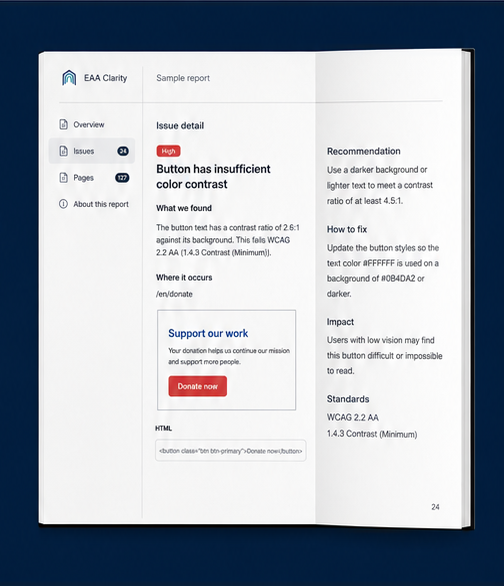
A report built for remediation decisions
Prioritised findings
Every issue includes affected users, severity, location, evidence, and a clear route to resolution.
Risk summary for decision-makers
A concise risk picture for leadership, procurement, product, and compliance stakeholders.
Fix guidance and retesting
Practical guidance for design, content, and engineering, plus optional verification.
Coverage
The audit covers the parts customers use to complete a task.
- Keyboard access and visible focus
- Screen-reader structure and names
- Forms, errors, and validation
- Colour, contrast, and text resizing
- Navigation and interactive controls
- Checkout and account journeys
- Documents and embedded media
- Responsive and touch interaction
Three clear stages
From scope to verified fixes
- ScopeWe identify the services, journeys, markets, and evidence you need.
- AuditWe test representative flows with manual and automated techniques.
- ActYou receive prioritised findings, a walkthrough, and optional retesting.
Built for the European context
The European Accessibility Act applies through national laws and can affect products and services placed on the EU market. Scope and obligations vary, so our technical work supports legal assessment but does not replace it. Read the official Directive (EU) 2019/882.
Questions
Start with the essentials
Is an automated scan enough?
No. Automation finds a useful subset of issues; it cannot reliably judge task completion, interaction clarity, focus behaviour, or the quality of alternatives.
Do you certify legal compliance?
No. We provide independent technical evidence and remediation guidance. Legal applicability and compliance decisions should be confirmed with qualified counsel.
Can you review fixes?
Yes. A focused verification pass can confirm whether agreed findings have been resolved and identify any regressions.
Start with the right scope